Publication: Intraspecific behavioural and environmental contexts influence collective risk of microplastic ingestion in a social fish
Publication: Intraspecific behavioural and environmental contexts influence collective risk of microplastic ingestion in a social fish
Wed, Jun 03 2026
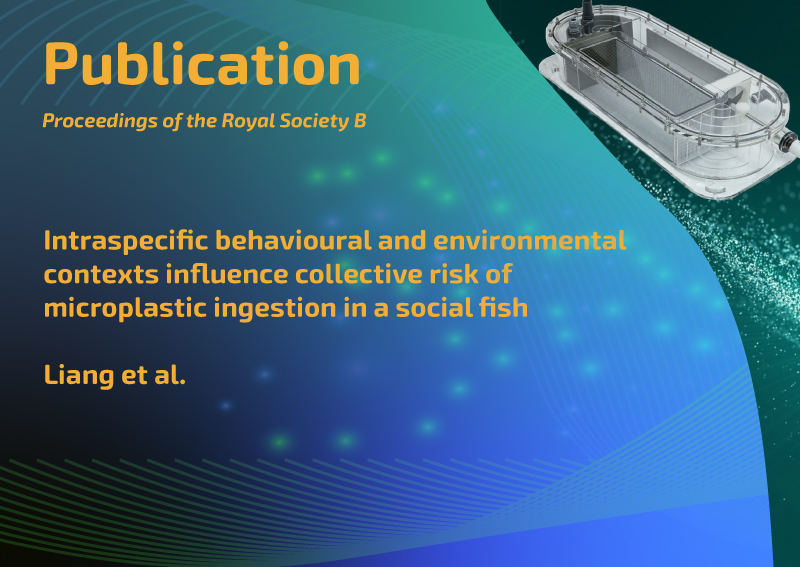
A recent study from the Killen lab (SBOHVM, Glasgow) made novel use of our swim tunnels to study how social hierarchies affect the ingestion of microplastics in static or flowing conditions.
Using European minnows (Phoxinus phoxinus) they tested the ingestion behaviour of different dominance social hierarchies during static water and controlled flow conditions.
They found that steep hierarchies with highly dominant individuals demonstrated increased ingestion of microplastic in the most dominant individual, but swallow rates were only increased in the flow condition.
Interestingly, the less dominant fish in groups with steep hierarchies were more effective at rejecting microplastics. At the overall group level, the total microplastic ingestion was unchanged compared to the other conditions, highlighting how concentrated the microplastic exposure was in the most dominant individual.
The findings demonstrate how traits that are usually associated with success can increase the pollution risk from microplastics and other contaminants. Potentially, leading to changes in group dynamics as the individuals and groups are affected to different degrees depending on both the social and physical environments that they live in.
The paper titled Intraspecific behavioural and environmental contexts influence collective risk of microplastic ingestion in a social fish is published in Proceedings B and can be found online at https://doi.org/10.1098/rspb.2026.0384
Do you want to learn more about the Swim Tunnel system used in this paper?