



Wed, Oct 21 2026
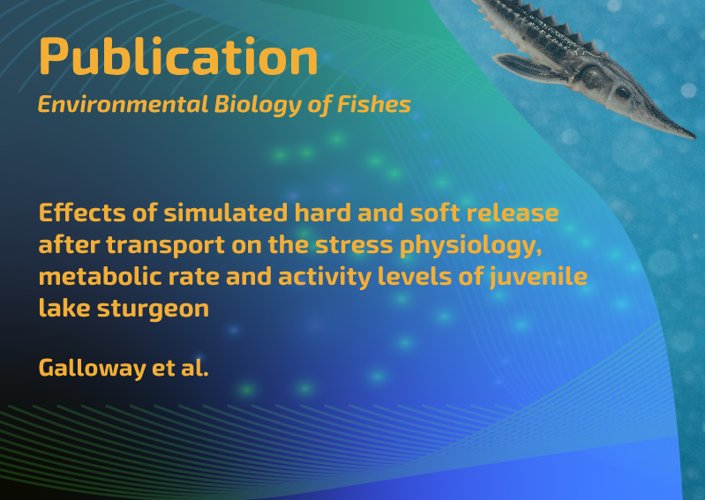
Publication: Effects of simulated hard and soft release after transport on the stress physiology, metabolic rate and activity levels of juvenile lake sturgeon
A recent study published in Environmental Biology of Fishes investigated whether soft-release strategies can help juvenile lake sturgeon (Acipenser fulvescens) recover from the physiological stress associated with transport. Olivia M. Galloway and colleagues found that allowing fish to recover for 24 hours before release helped restore metabolic rate and reduce other indicators of transport stress.
Transporting hatchery-reared fish is an important component of stocking and reintroduction programs, but transport, handling, loading and release can be physiologically demanding.
To investigate this, the researchers simulated a conventional stocking event by transporting juvenile lake sturgeon for six hours. The fish were then assigned to either an immediate hard release or a soft release with a 24- or 48-hour acclimation period. A non-transported group provided baseline measurements. By conducting the release treatments within a controlled hatchery system, the researchers could isolate the physiological effects of the release strategy from the additional effects of entering a novel natural environment.
The study combined several measures of the physiological stress response, including cortisol, glucose, lactate, metabolic rate and swimming activity. This allowed the researchers to investigate different components of recovery rather than relying on a single stress indicator.
Metabolic rate was measured using intermittent-flow respirometry. Six 5 L chambers, controlled by AutoResp™ controlled the flush cycles and automatically calculated mass-adjusted oxygen consumption during each measurement period.
The experimental design allowed the researchers to compare several aspects of metabolism. Routine metabolic rate was measured in non-transported fish, while maximum metabolic rate was determined following an exhaustive chase. Immediately following transport, the researchers measured the metabolic rate of hard-release fish and subsequently followed the same group overnight to determine metabolic rate after 24 hours of recovery.
Immediately following transport, the metabolic rate of the hard-release fish was significantly higher than the routine metabolic rate of both baseline and 24-hour soft-release fish. Their metabolic rate immediately after transport was not significantly different from the maximum metabolic rate measured after exhaustive exercise.
After 24 hours, however, metabolic rate had returned to baseline levels. The authors interpreted the high oxygen consumption immediately following transport as evidence that the fish were expending considerable energy during transport and could therefore have little remaining capacity for activities such as predator avoidance and foraging if released immediately.
The metabolic results were supported by other physiological and behavioural measurements. Hard-release fish had higher lactate than the 24-hour soft-release fish at the time of release, while activity also differed between release treatments. Cortisol remained elevated relative to baseline across all three transported groups, demonstrating that different components of the physiological stress response recovered at different rates.
Together, the metabolic rate, lactate and activity measurements indicated that juvenile lake sturgeon recovered from important components of transport stress within 24 hours under soft-release conditions. Based on these findings, the authors recommend a 24-hour soft release for captive-reared juvenile lake sturgeon to allow physiological recovery while providing a predator-free acclimation period before release.
The study demonstrates how combining respirometry with blood physiology and behavioural measurements can provide a detailed picture of recovery following transport. Importantly, the metabolic measurements showed not only that transport was energetically demanding, but also how quickly that energetic cost subsided under soft-release conditions.
The paper,“Effects of simulated hard and soft release after transport on the stress physiology, metabolic rate and activity levels of juvenile lake sturgeon” was published in Environmental Biology of Fishes in 2026 and can be found online at https://doi.org/10.1007/s10641-026-01897-7
Do you want to learn more about the respirometry tools used in this paper?
About
At Loligo® Systems, we are dedicated to advancing aquatic biology research by providing state-of-the-art equipment and innovative solutions. Our expertly designed products empower scientists worldwide to excel in various research fields, including aquatic respirometry, swimming performance, blood gas physiology, and animal behavioral analysis for a wide range of marine and freshwater organisms.
Based on 20 years of experience, we understand the diverse and dynamic needs of the scientific community, which is why we offer bespoke solutions tailored to your unique research requirements. Our team of experienced professionals is committed to providing unparalleled scientific advice and support, ensuring that you receive the most accurate and reliable data possible.
Loligo® Systems: Empowering aquatic research, together.